← About me & projects
Supporting · portfolio construction
Risk parity
How should risk be balanced across asset classes?
This portfolio weights S&P 500 e-mini, gold and 10-year Treasury futures so each contributes similar risk, from 2015 to 2025, and compares the result with an equal-weight mix.
$1.61risk parity growth of $1
$2.36equal weight growth of $1
~16%2022 drawdown, both
3futures markets
How it works
- Volatility. Estimate each asset’s volatility over a rolling 36-day window.
- Inverse-volatility weights. Weight each asset by one over its volatility, so calmer assets such as bonds get more weight.
- No look-ahead. Weights use only yesterday’s data; the risk-free rate comes from the 13-week T-bill.
- Rebalancing and costs. Daily, weekly or monthly rebalancing, with turnover costs in basis points.
Results
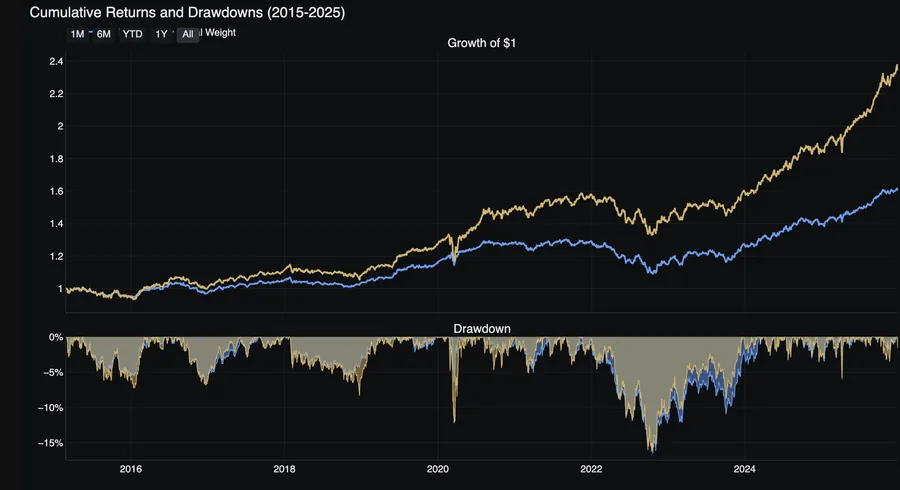
Lower growth, similar drawdowns
Growth of $1 for risk parity (blue) and equal weight (gold), with drawdowns below.
- Both fell about 12% in March 2020 and about 16% in 2022.
- 2022 hit bonds as hard as stocks, the case risk parity handles worst; equal weight also held more of the gold and stock rally since 2023.
Values are read from the chart.
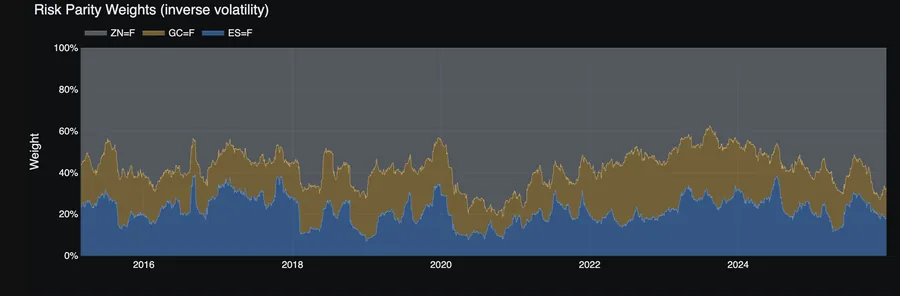
Bonds carry most of the weight
Because Treasury futures are the calmest of the three, they usually hold about 40–80% of the portfolio. Stocks range from roughly 10% to 40%, shrinking after volatility spikes such as early 2020 and growing in calm markets; gold fills the rest.
Values are read from the chart.
How I tested this
- Data
- Daily S&P 500 e-mini, gold and 10-year Treasury futures, 2015 to 2025.
- Out-of-sample test
- Weights use a trailing 36-day window and are applied the next day, so every trade uses only past data. The rule has no fitted parameters.
- Costs
- Zero in the reported run; the backtest can charge costs on turnover, and monthly rebalancing keeps them small.
- What this does not show
- Three assets and one decade, with no leverage or volatility target, so the result says little about a full multi-asset risk-parity fund.
Takeaways
- Balance is not the same as return. Risk parity spreads risk evenly, but in a stock-and-gold bull market it gives up return.
- Correlation regimes matter. When bonds and stocks fall together, as in 2022, the diversification it relies on disappears.
- Next step. Add a volatility target so the lower-risk mix can be levered to a chosen risk level.
In the repository
View on GitHub: damion-m/Quantitative-Strategies
risk_parity_backtest.ipynbfunc_lib.py